
Do you perform better by drinking beetroot juice?
Published: 20 March 2026
Last updated: 20 March 2026
Reading time: 2-3 minutes
Categories Supplements
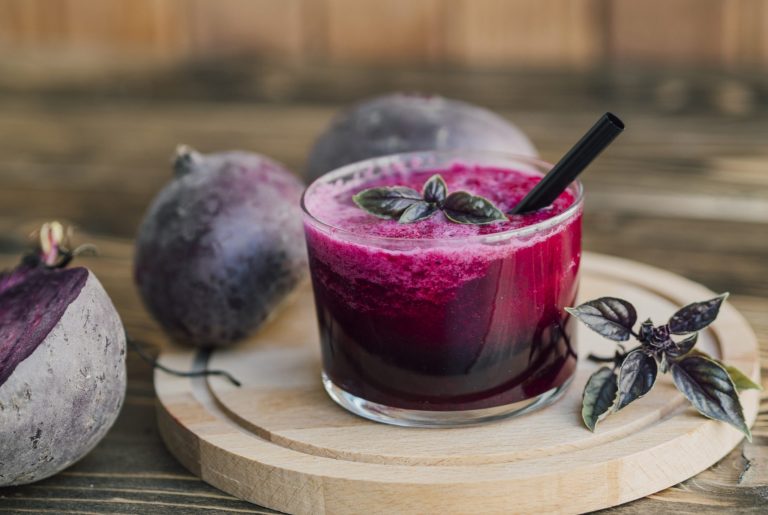
You're seeing it more and more on the sidelines at running races: athletes downing a small, dark red bottle before the start. Beetroot juice. Some swear by it, others look at it a bit strangely. But does it really work? And if so, for whom? As a sports nutrition coach, I'm not easily enthusiastic about supplements, but with beetroot juice, there's enough evidence to take it seriously. With one big caveat: it's not a miracle cure.
What does beetroot juice do to your body?
Beetroot is packed with nitrate. That may not sound exciting, but your body does something special with it. Nitrate is converted by bacteria in your mouth into a substance that widens your blood vessels slightly. This allows more blood, and therefore more oxygen, to flow to your working muscles.
The result? Your muscles work a bit more efficiently. With the same effort, you can maintain your tempo for slightly longer, or cover the same distance with slightly less effort. Research shows that the performance gain for recreational and moderately trained athletes is between 1 and 3 percent.https://link.springer.com/article/10.1007/s40279-025-02194-6That sounds like a small amount, but in practice, it can make all the difference. A large review study from 2025 in Sports Medicine, which summarises 20 meta-analyses and 180 studies, confirms that nitrate supplementation measurably improves endurance.
Important to note: this effect is strongest in recreational and amateur athletes. In elite athletes, people with extremely high endurance, the effect is much smaller or even absent. Their bodies already work so efficiently that beetroot juice can add little more. A review study published in June 2025 in Nutrients (https://pmc.ncbi.nlm.nih.gov/articles/PMC12195723/) specifically confirms this: recreational athletes clearly benefit more than professional athletes. For most people reading this, that's actually good news.
Which sports is it interesting for?
Beetroot juice is most researched in endurance sports: running, cycling, and swimming. It works best for efforts where you need to maintain a high pace over a longer distance. Think of a 5k run or a cycling time trial. For longer, slower endurance efforts, the results are less conclusive. And for explosive, very short-duration efforts, such as a 100-metre sprint or a set in the gym, the evidence for beetroot juice is far less convincing.
Research has also been conducted on interval sports such as football and other team sports. In these, positive effects have been found on the ability to perform repeated sprints. The type of explosive actions that are common in team sports. This makes beetroot juice also interesting for athletes who do not purely engage in endurance sports.
How do you use it in practice?
If you want to try it out, these are the main points:
Choose the correct product. Concentrated beetroot juice shots (like those from the Beet-It brand) are more practical than a large glass of regular beetroot juice. A shot typically contains 400 mg of nitrate, which is equivalent to about half a litre of regular beetroot juice.
Use it in time. Drink your shot 2 to 3 hours before your training session or match. Your body needs that time to convert the nitrate. If you wait too long, you'll miss the optimal moment.
One-off or build-up? Both work. Single use is effective: the nitrate levels in your blood are comparable to multi-day use. Multi-day use (3 to 6 days in advance) is recommended by many sports nutrition organisations, but a proven performance difference compared to single use is lacking. Always test it during a training session first, never for the first time on race day.
Skip the mouthwash. This is a detail many people miss: do not use antibacterial mouthwash or toothpaste immediately before or after taking it. They kill precisely the bacteria in your mouth that convert nitrate. So brushing your teeth and mouthwash: do it well in advance.
Pink toilet visit. Don't be alarmed: your urine and faeces can turn pink or red. This is completely harmless, but it's good to know so you aren't unnecessarily frightened.
My honest opinion
As a sports nutrition coach, I'm always cautious with supplements, and here too, a few nuances are important.
Beetroot juice is no substitute for good nutrition and training. If you're not getting enough sleep, eating too few carbohydrates, or your training schedule is wrong, a beetroot juice shot will make no difference. Always start with the basics.
Furthermore, not everyone reacts the same way. There are so-called ‘non-responders’: people for whom beetroot juice has little to no effect. The exact size of this group is not known. The only way to find out if you will benefit from it is to test it yourself during a training session.
And then there's long-term safety. The Dutch Nutrition Centre (https://www.voedingscentrum.nl/nl/service/vraag-en-antwoord/veilig-eten-en-e-nummers/is-bietensap-gezond-of-gevaarlijk-voor-fanatieke-sporters.aspxadvises caution with the daily consumption of concentrated beetroot juice, as the long-term effects have not yet been sufficiently researched. This seems to contradict the recognition by NOCNSF. But the difference lies in the purpose. NOCNSF looks at performance improvement in athletes, the Voedingscentrum (Nutrition Centre) at long-term public health. Both viewpoints are understandable. The recommendation: use it targeted: around a competition or important training session, and not structurally every day.
But if you're a recreational or amateur athlete preparing for a competition and you have your basics in order? Then beetroot juice is one of the few supplements where the scientific evidence is strong enough to be taken seriously. It's not for nothing that NOC*NSF has included it in the official nutrition protocol for athletes.
Would you like to know if and how beetroot juice fits into your nutrition strategy? Feel free Contact Sure. I'd be happy to brainstorm with you.
Read also: To Omega-3 or not to Omega-3?
Read also: Creatine supplement: the proven remedy for every athlete
Get more out of every workout
Discuss your situation during a personal initial consultation.