
Creatine supplement: the proven remedy for every athlete
Published: 8 September 2025
Last updated: 8 September 2025
Reading time: 5-6 minutes
Categories Supplements
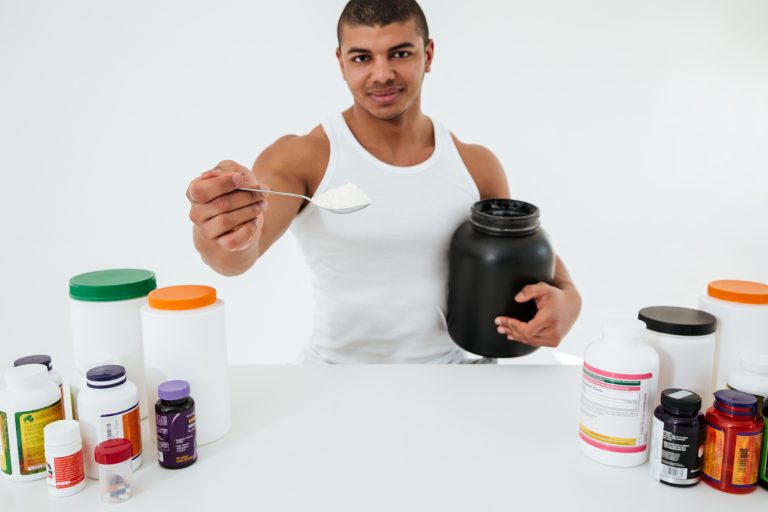
As a recreational athlete, you've probably heard of the creatine supplement. That white powder bodybuilders are so enthusiastic about. But a creatine supplement is much more than just a tool for gym buffs. It can also improve your performance, whether you're running, playing tennis, or football.
Recent research is increasingly showing benefits that go beyond just muscle growth. From improved brain function to injury prevention. The creatine supplement is proving to be one of the most versatile aids we know.
What does a creatine supplement actually do?
A creatine supplement acts as a sort of turbo boost for your muscles. It helps your body generate energy quickly during short, intense bursts of exercise. In practice, this often translates to 5–10% more strength and power, a few extra reps at the gym, or being that crucial second faster when it really counts.
This is where it gets interesting: a creatine supplement does much more than just help your muscles. Recent research shows that taking creatine has clear effects on memory, concentration, and how quickly you process information.https://www.frontiersin.org/journals/nutrition/articles/10.3389/fnut.2024.1424972/fullFollowing strenuous exercise, creatine helps your mental sharpness recover more quickly.
Interestingly, a creatine supplement can also help with mental stress and may even reduce symptoms of depression. New research from 2024 even shows that a single high dose of creatine can improve cognitive performance during sleep deprivation.https://www.nature.com/articles/s41598-024-54249-9The mechanism appears to relate to improved energy management in the brain, which helps in coping with stressful situations.
Furthermore, the creatine supplement can help with injury prevention. Research among American college football players showed that users had significantly fewer cramps, muscle injuries, and a lower total number of injuries (https://jissn.biomedcentral.com/articles/10.1186/s12970-017-0173-z).
A creatine supplement works particularly well for strength training, but it is helpful in any sport with short, explosive moments. Football, hockey, basketball, tennis, martial arts: all sports that involve regular short sprints, sudden changes of direction, or powerful movements. Even endurance athletes can benefit from improved final sprints.
How can you use a creatine supplement effectively?
For recreational athletes, 3-5 grams per day is more than enough. You can simply mix it into your shake or dissolve it in a glass of water. Consistency is more important than perfect timing.
When is the best time to take creatine? New research suggests that taking it immediately after your workout may be slightly more effective than taking it before. One study showed that people who took creatine after their workout had slightly more muscle growth and strength gains than those who took it before.https://jissn.biomedcentral.com/articles/10.1186/1550-2783-10-36The theory behind this is that your muscles are extra well-perfused after training, making them more receptive to absorbing nutrients. Handy tip: the supplement also works better when combined with carbohydrates, so having it with your banana after your workout is fine. But the difference is small. The most important thing is to take it daily.
Many athletes take both creatine and caffeine, but do they work well together? This is a subject on which science has yet to make a definitive statement. Earlier research from 1996 suggested that caffeine could reduce its effect, but this was based on only 9 participants. Recent research shows mixed results: a 2015 review found no direct interaction between the substances in the body, but did suggest that caffeine could blunt the performance-enhancing effect.
What we know now: for strength training, the combination appears less effective than creatine alone; in speed sports like sprinting, they may actually enhance each other; dosage plays an important role. High doses of caffeine (400+ mg per day) seem more problematic, and individual sensitivity varies greatly.
To make the most of your supplement, consider not taking creatine and caffeine at the same time, leaving a few hours between doses, limiting your caffeine intake on days you take creatine, and experimenting to see what works best for you. The most important thing is that both substances are individually proven to work well for athletes. The potential negative interaction is likely small and warrants further research.
Women often respond differently to creatine supplements than men. Interestingly, women naturally have 70–80% lower creatine stores in their muscles than men (https://pmc.ncbi.nlm.nih.gov/articles/PMC7998865/This means that women may benefit more from supplementation. Furthermore, hormonal fluctuations during the menstrual cycle can influence how effective creatine works.
Creatine supplementation can also contribute to muscle growth, but only in combination with strength training. It works in two ways: firstly, creatine helps you lift more weight and do more repetitions. Secondly, creatine causes your muscle cells to retain more water, making them swell and this activates processes that lead to muscle growth. Research shows that people who take creatine while regularly strength training build slightly more muscle mass on average.https://pmc.ncbi.nlm.nih.gov/articles/PMC10180745/).
The practice and important tips for your creatine supplement
It usually takes about 2-4 weeks to really notice the effects of creatine supplementation. You might experience slight water retention (1-2 kg), but this is just water being stored in your muscles along with creatine. It's not fat gain.
Important to note: not everyone responds equally well to a creatine supplement. Around 20–30% of people are ‘non-responders’. They naturally have high levels of creatine in their muscles and see fewer benefits (https://pmc.ncbi.nlm.nih.gov/articles/PMC10180745/Vegetarians often respond better because they naturally have lower creatine levels.
Online, you often see complicated ‘loading schedules’ where you have to take 20 grams per day for the first week. This is unnecessary for recreational athletes and can cause stomach upset. Simply taking 3-5 grams per day works perfectly well. It just takes 2-4 weeks longer to saturate your muscles, instead of 1 week.
The supplement is perfectly safe for healthy individuals, but taking too much offers no extra benefits and can cause stomach pain and diarrhoea. More than 10 grams at once is just excreted. A complete waste of money if you ask me! Keep it simple: 3-5 grams a day, every day.
Just buy creatine monohydrate, the simplest and cheapest form. This is also the form that's used in virtually all research. All the fancy variants like creatine HCl, creatine ethyl ester, or ‘buffered’ creatine are usually expensive marketing with no proven added benefit.
The supplement works best for athletes who regularly engage in short, intensive efforts. Think of strength athletes, team sports players like footballers and hockey players, racket sports players, martial artists, and sprinters. However, endurance athletes can also benefit from creatine, especially for better final sprints or if they do multiple training sessions per day.
Vegetarians and vegans often benefit additionally because creatine is mainly found in meat and fish. For them, supplementation can be particularly advantageous, both for physical and mental performance. Older athletes (from around 30 years of age) begin to slowly lose their natural creatine levels. For older recreational athletes, the supplement can help counteract muscle loss and maintain the quality of training.
This supplement isn’t a miracle cure, but it is a reliable way to get that extra bit out of yourself. With over 500 scientific studies to back it up, it’s one of the few supplements you can really rely on.
My experience with creatine
I myself started four weeks ago with 3 grams of creatine per day. Just the simple monohydrate after dinner, dissolved in a glass of water. This is the most practical moment for me and combines well with the carbohydrates from my evening meal. After about 2.5 weeks, I noticed the first effects during my Brazilian Jiu-Jitsu training: I could maintain the same intensity level for longer during rolling without my strength fading. I also notice in strength training at the gym that I can complete those last few repetitions better.
The effect is not dramatic, but it is clearly noticeable. As a vegetarian over 50, I seem to respond well to creatine and am curious to see how it develops further in the coming weeks. So far, no side effects, only a slight increase on the scales (probably water in the muscles as expected).
As someone who is typically quite cautious and reserved about supplements (I'm a proponent of getting your basic nutrition and sports-specific nutrition right first), I have to say that creatine is one of the few that I genuinely feel positive about. The overwhelming scientific evidence, its simple mechanism of action, and my own experience make it a no-brainer for me. Whether you're a recreational athlete looking to get a bit more out of your training, or someone seeking mental sharpness, chances are you'll benefit from it too. And if it doesn't work? Well, you've experimented with your performance for a month for the price of a few coffees. That risk is certainly worth it.
Get more out of every workout
Discuss your situation during a personal initial consultation.