
Exercising in extreme heat: how hydration and nutrition affect your performance (and safety)
Published: 8 August 2026
Last updated: 8 August 2026
Reading time: 5-6 minutes
Categories Hydration
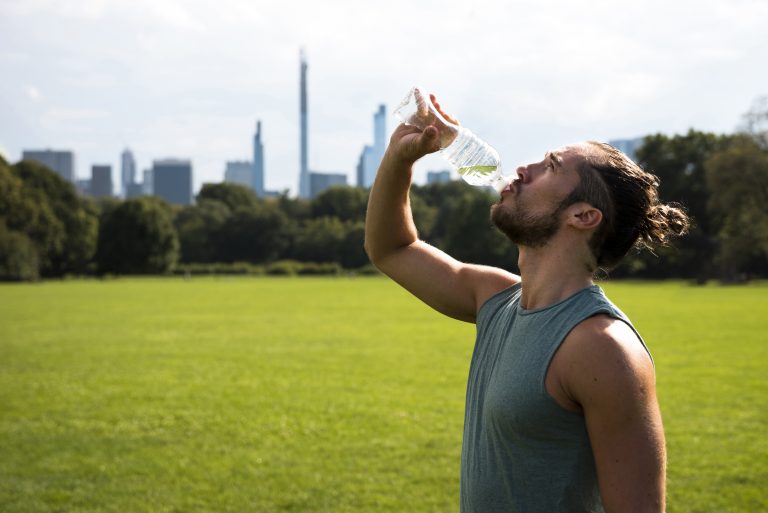
We’re having another hot summer. Lovely! But how do you train in these conditions? That’s what this blog is about.
After all, a tropical day brings with it a familiar dilemma for athletes: am I drinking too little, or too much? Both extremes can throw a spanner in the works: from a disappointing performance to, in the worst-case scenario, a medical problem. In this article, you’ll learn how hydration and nutrition work together when exercising in (extreme) heat, and how to develop a simple, reliable strategy rather than relying on your sense of thirst.
How heat affects your body
When exercising in hot conditions, your body has to do two things at once: supply your muscles with energy and keep your core temperature within safe limits. The latter requires blood volume. Some of your blood is directed to the skin to dissipate heat through sweating. The result is that, for the same level of exertion, your heart rate rises more quickly than on a cool day, and your sweat loss can increase significantly – from around one litre per hour to, in extreme cases, as much as three litres per hour – depending on the temperature, humidity and your own physiology.
This is precisely why “just drinking more” isn’t the whole story. Fluid levels and the right electrolytes must remain in balance; otherwise, you’re still at risk – in both directions.
Before the training session: the right preparation
Don’t start a training session in the heat whilst dehydrated. A widely accepted guideline is to drink around 500 ml of fluid about two hours before exercise, so that your body has time to excrete any excess fluid before you start. For longer or more strenuous exercise in the heat, it may also be a good idea to lightly replenish your fluids with electrolytes beforehand, especially if you know you produce salty sweat.
During training: fluid and electrolyte balance
Thirst is a surprisingly unreliable guide. By the time you feel thirsty, you’re often already somewhat dehydrated. It’s better to drink on a regular schedule, tailored to your own rate of perspiration.
What do the sports nutrition guidelines actually say? During exercise, it is recommended that you drink at a rate that is close to your rate of sweat loss, with a practical range of approximately 400 to 800 ml per hour during longer, intense exercise. In cases of very high sweat rates and extreme heat, this can rise to between 600 and 1,200 ml per hour. For exercise lasting longer than an hour, it is advisable to add both carbohydrates and sodium to your drink: this maintains your energy levels and helps you retain fluid more effectively.
Important to know: Water alone is not always the best choice during prolonged, strenuous exercise. Pure water without sodium can, particularly during prolonged exercise and when consuming large volumes of fluid, increase the risk of hyponatraemia.
Hyponatraemia: the opposite risk
Whilst most people fear dehydration, hyponatraemia is at least as real a risk during exercise in hot weather and is often overlooked. It occurs when you drink too much water without replenishing sufficient sodium, causing the sodium level in your blood to drop too low. Initial symptoms resemble those of dehydration (nausea, confusion, headache), which can be misleading, but the solution is exactly the opposite: drink less, consume more sodium. An isotonic sports drink containing electrolytes, rather than plain water, is your best safeguard in this situation.
Warning signs: recognising heatstroke
As well as hyponatraemia, heatstroke is the risk you need to be aware of. It is important to understand the difference between this and mild heat exhaustion:
- Heat exhaustion: excessive sweating, tiredness, slight dizziness, nausea, pale skin. Annoying, but manageable by stopping, cooling down and drinking.
- Heatstroke: confusion, a lack of sweating whilst the skin feels hot and dry, a very high heart rate, and possible loss of consciousness. This is a medical emergency! Stop immediately, actively cool down and seek help.
Are you having second thoughts during a training session or match? Stop! A drop in performance is never worth the risk.
After training: recovery
Rehydration is most effective within the first two hours after exercise. A useful rule of thumb: drink about one and a half times the amount of fluid you lost during your training session (measured by the difference in weight before and after training), supplemented with enough sodium to ensure you actually retain the fluid. Food containing a little salt and carbohydrates is just as effective for this as a sports drink.
Common mistakes & fixes
- Error: wait until you’re thirsty. Fix: Drink on a regular schedule, based on your own rate of perspiration.
- Error: During long, hot training sessions, drink only water. Fix: Choose an isotonic drink containing electrolytes as soon as you’ve been exercising for more than an hour.
- Error: drinking huge amounts of water beforehand “just to be on the safe side”.” Fix: Spread your fluid intake evenly over the hours leading up to exercise, ensuring you consume a normal amount of sodium.
- Error: ignore the signs of heat exhaustion and “grit your teeth and carry on.” Fix: Recognise the signs early and cut back or stop.
My own experience
Back when I was a keen marathon runner, I regularly trained in temperatures above 25 degrees during the summer months. Staying hydrated was crucial during long endurance runs. In hot weather, I always carried a 2-litre Camelbak with me, filled with an isotonic sports drink containing electrolytes. I drank at least 500 ml every hour, depending on the temperature. That was exactly within the recommended range. With that approach, I managed to keep going well, even on the hottest days.
Practical takeaways
- Know your own sweat rate; there’s no universally correct figure.
- Guideline during exercise: approximately 400–800 ml per hour, with electrolytes for exercise lasting more than 1 hour.
- Don’t rely on feeling thirsty; drink according to a schedule.
- Recognise the difference between heat exhaustion and heatstroke, and stop if in doubt.
- Afterwards: make sure you rehydrate properly, not just with water.
Would you like to sort this out for yourself?
Everyone sweats differently, and the right hydration and nutrition strategy depends on your body, the sport you do and the intensity of your training. With the TWINDO app (Try it for 7 days free) You’ll receive personalised sports nutrition advice tailored to you as an athlete: a solid foundation that enables you to make informed choices even in hot conditions, rather than just guessing.
Get more out of every workout
Discuss your situation during a personal initial consultation.